What I Learned Training NHL Prospect Ryden Evers This Summer
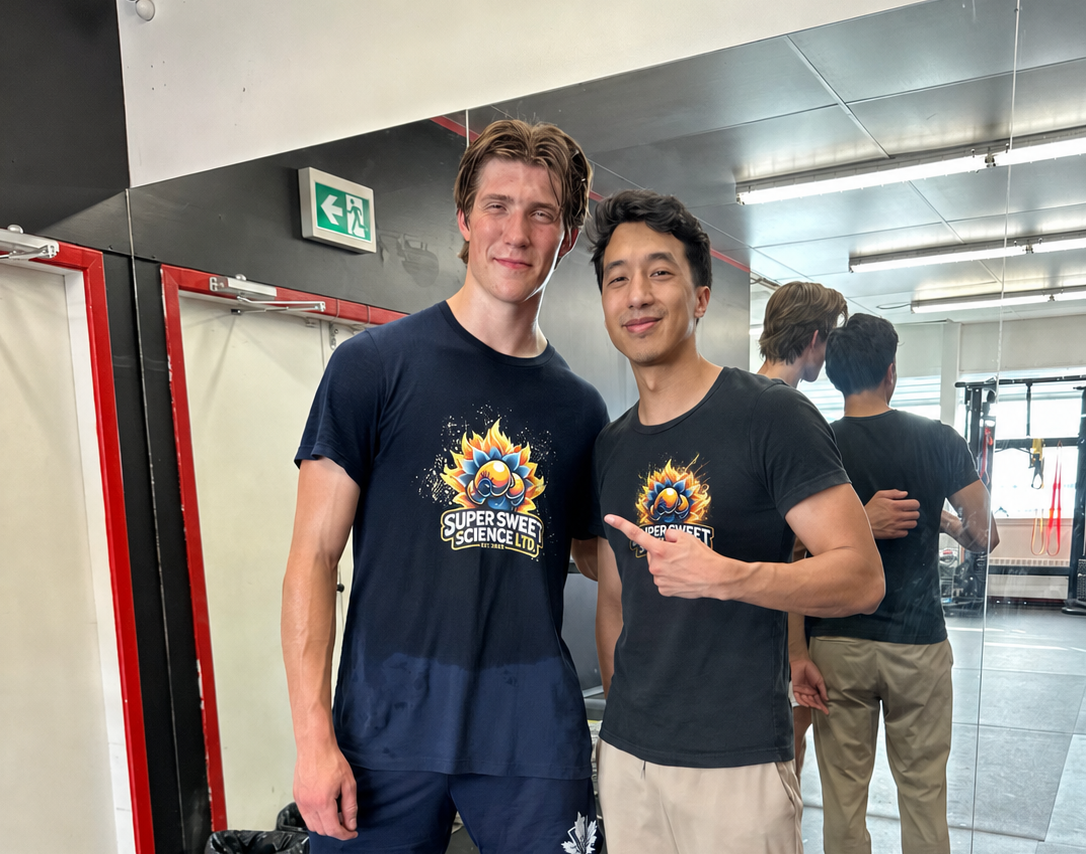
As much as I love boxing—and as passionate as I am about teaching and sharing the sweet science with people who want to grow in the sport—I never really imagined that someone like Ryden Evers would eventually stumble across my path.
I definitely never thought that one day I'd be teaching boxing to an athlete who had just signed an NHL contract.
Ryden and I started training together this summer, during an interesting point in his career.
His season with the Penticton Vees had just wrapped up after a run to the WHL Western Conference Championship, and a few months earlier he had signed a three-year entry-level contract with the Seattle Kraken.
So this wasn't Ryden deciding that he suddenly wanted to become a boxer.
He was simply in his offseason.
He wanted to have some fun, learn something new, stay active and add another type of training to what he was already doing while he waited for the next hockey season to begin.
Ryden told me that the likely next step in his development would be playing with the Coachella Valley Firebirds, Seattle's AHL affiliate, while remaining part of the Kraken organization and working toward eventually earning an NHL roster spot.
And somewhere in the middle of all of that, he decided to take on Private lessons from us and learn how to box.
MY FIRST IMPRESSION
Before meeting Ryden, I had done a little bit of research because I knew he was a high-level hockey player.
That's when I realized just how high-level he actually was.
He grew up locally and came through the Burnaby Winter Club program before eventually playing junior hockey with teams including the Vernon Vipers, Surrey Eagles and Penticton Vees.
Then Seattle signed him as an undrafted free agent.
And shortly afterward, he showed up to train boxing with me.
If you met Ryden without knowing any of that, you probably wouldn't guess it from the way he carries himself.
My immediate impression was that he was a really humble kid.
Physically, of course, you could tell he was an athlete. He's tall, lean and athletic, with that slightly lanky build boxing coaches tend to love. Long limbs give you some interesting tools to work with in boxing.
But personality-wise, he just seemed like a normal young guy coming in to learn something new during his summer.
What became obvious pretty quickly, though, was that I wasn't dealing with a normal beginner.
WHAT OTHER SPORTS GIVE YOU IN BOXING
Over the years, I've noticed that people who already have experience in other sports often pick up certain aspects of boxing faster.
Exactly what transfers seems to depend heavily on the sport.
I've had people from sports like basketball and badminton understand things such as stance, balance and generating force through the body surprisingly quickly. Other sports don't necessarily give someone the same immediate head start.
With Ryden, the transfer was obvious.
Even when we were starting with basic boxing mechanics, his movements were sharp.
His punches had pop.
He understood how to coordinate his body and generate force remarkably quickly.
There are still boxing-specific movements that every beginner has to learn, no matter how athletic they are. Being an elite hockey player doesn't magically make someone a boxer.
But it certainly gives you a pretty ridiculous foundation to build from.
One of the biggest things I noticed with Ryden was simply his awareness of his own body.
If I explained how I wanted him to shift his weight, rotate, change his positioning or generate force from a certain angle, he seemed to understand the physical problem very quickly.
He might not have known the boxing movement yet.
But he knew how to make his body learn it.
HOCKEY & BOXING HAVE MORE IN COMMON THAN I EXPECTED
Training Ryden also made me realize how much crossover there can be between the physical demands of hockey and boxing.
Both sports reward athletes who can produce a lot of force very quickly.
You need explosive acceleration. You need the ability to repeatedly produce short bursts of high output. You need strength without becoming slow or stiff. You need coordination, balance and the ability to maintain those qualities while you're fatigued.
At the end of the day, regardless of the sport, an elite athlete needs to be strong, explosive and functional.
Ryden was a pretty good demonstration of that.
His conditioning in particular is ridiculous.
I don't think I've ever seen the guy genuinely huffing and puffing.
I've put him through boxing sessions where I'm watching for the usual signs of fatigue—the hands slowing down, feet getting heavier, posture starting to change, breathing becoming more noticeable—and he just keeps going.
Of all the boxing athletes I've personally trained, Ryden probably has the best overall conditioning I've encountered.
That's one of those moments where you go:
Okay. Yeah. This is what an elite-level athlete looks like.
LEARNING BOXING AS AN ELITE ATHLETE
The other thing that impressed me was how quickly Ryden could take a new movement and make sense of it.
I even introduced him to some of the Soviet-style footwork that I teach.
That's not something I expect somebody to immediately look comfortable doing, especially when they're relatively new to boxing.
But once again, he picked it up surprisingly quickly.
Although the footwork did claim one casualty.
By the end of one session, he had managed to develop a blister on his foot that actually ripped open.
So apparently even NHL-level conditioning doesn't make your feet immune to boxing.
Ouch.
But that ability to learn movement quickly kept showing up throughout our sessions. His understanding of his own body—balance, leverage, force production and coordination—is clearly very developed.
That's probably one of the biggest differences I've noticed between teaching an experienced elite athlete and teaching the average beginner.
It's not necessarily that they already know the movement.
They don't.
It's that when you give them a new physical problem, they seem to have a much bigger library of movement to draw from while solving it.
I ALSO ENDED UP LEARNING ABOUT HOCKEY
One of the unexpected parts of training Ryden has been how much I've learned from him.
I knew very little about hockey culture going into this.
At one point we got onto the subject of fighting in hockey, and Ryden explained the history of players whose role on a team was heavily connected to being able to fight—the classic hockey "enforcer."
That blew my mind a little.
Fighting isn't technically part of hockey in the same way passing, shooting or checking are. Players are penalized for doing it.
Yet fighting developed its own culture within the sport, and historically there were players whose ability to protect teammates, intimidate opponents and fight became an important part of the role they played on a team.
Naturally, when you're a boxing nerd and somebody tells you this, your brain starts going to work.
It gave us an opportunity to look at how actual boxing concepts could be modified for the very unusual environment of a hockey fight.
You obviously can't just box normally while standing on skates, wearing hockey equipment and potentially holding onto another person's jersey.
So we played with concepts like arm control, clinch positioning, leverage and understanding where force can be generated from when your normal boxing stance isn't available.
In our most recent session, we spent quite a bit of time working on pull counters.
A pull counter is essentially what it sounds like: you make somebody's punch fall short by pulling your head and upper body just outside its range, then immediately fire back while they're still extended or recovering.
For a boxer, it's a classic counterpunching concept.
But when I started thinking about what Ryden could realistically apply if he ever found himself in a hockey fight, it made even more sense.
Because of the restricted environment, he isn't necessarily going to have the freedom to slip, pivot and move around the way a boxer would inside a ring. If somebody is holding onto him or throwing a punch from close range, creating just enough distance for that punch to miss and immediately answering back can be much more practical.
So instead of trying to turn Ryden into a "boxer on skates," the question became:
Which parts of boxing still work when you take away most of boxing's normal environment?
That's been one of my favourite parts of training him.
It's a really interesting coaching puzzle.
I'm teaching him my sport, but at the same time he's forcing me to think about boxing from a completely different perspective.
"I DON'T REMEMBER LEARNING HOCKEY"
One conversation with Ryden stuck with me more than anything we did physically.
I asked him if he remembered his first time on the ice.
I wanted to know what learning hockey originally felt like to him—the first time he skated, the first time he picked up a stick, the feeling of slowly becoming better at this completely new skill.
He basically told me:
He doesn't remember.
Hockey has simply always been there.
He's been doing it since he was a toddler. It's such a fundamental part of his life that there isn't really a "before hockey" for him to look back on.
And for some reason, I found that fascinating.
Because I'm almost the opposite with boxing.
I do remember discovering it.
I remember what it was like when I started learning. I remember becoming obsessed with it. I remember leaving the gym and still thinking about boxing.
I'd shadowbox outside of training.
I'd watch fights.
I'd study techniques.
I'd consume anything boxing-related I could find because I wanted to understand more of it.
Eventually that obsession became a huge part of my life.
Now I'm teaching it.
Ryden's experience made me think about what happens when that kind of dedication starts even earlier.
He's only 21 years old, but hockey has essentially been his life's work already.
Thousands upon thousands of hours of skating, practicing, competing, training and improving have accumulated to the point where an NHL organization looked at him and decided they wanted to invest in where he could go next.
From the outside, signing an NHL contract can look like this massive moment that suddenly happens to somebody.
But when you hear the story behind it, it doesn't feel sudden at all.
It feels like the logical result of years and years of work.
WHAT I TOOK AWAY FROM TRAINING RYDEN
As a coach, I'm grateful I got the opportunity to work with him.
It's cool to say that I've trained an athlete signed to an NHL organization. I'm not going to pretend it isn't.
But that's not really the part of the experience that has stayed with me.
What has impressed me more is seeing what an elite athlete looks like up close.
The conditioning.
The coordination.
The ability to learn.
The humility.
And especially the amount of someone's life that can sit behind the level they're performing at today.
The funny thing is that boxing isn't even the main story for Ryden.
For him, this was something he decided to explore during his offseason. Something fun, something different, and something that could potentially give him another useful tool as an athlete.
For me, though, it became an opportunity to see my own sport through the eyes of someone who has already reached an incredibly high level in another one.
Ryden is now part of the Seattle Kraken organization, beginning the next phase of his career under a three-year NHL entry-level contract starting with the 2026–27 season.
I'm excited to see where that takes him.
Whenever he's back in town, hopefully we get to put the gloves on again.
And maybe the next time he walks through the gym doors, I'll be hearing about another big thing he's accomplished in hockey.
Either way, I'll be cheering for him.
And if Seattle eventually calls him up to the big club?
I'll probably be watching a lot more hockey than I used to.